
Understanding the Conventional Treatment Approach to Endometriosis
Understanding the Conventional Treatment Approach to Endometriosis
“Here Are Your Options…”
If you’ve been diagnosed with or suspect you have endometriosis, the treatment conversation often goes something like this:
Birth control
Pain medication
Surgery
And that’s usually where it stops.
For many women, this moment can feel both relieving and confusing.
👉 Relief that something is being offered
👉 Confusion about whether it actually leads to long-term healing
If you’ve ever felt that disconnect, you’re not alone.
What Conventional Care Focuses On
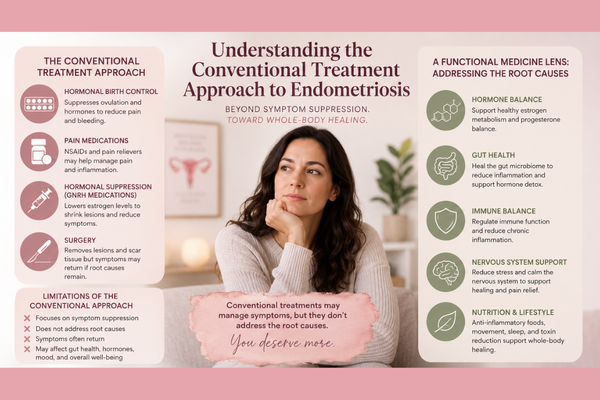
Conventional treatment for endometriosis is largely centered around symptom management.
That typically means:
Reducing pain
Controlling menstrual cycles
Slowing progression (when possible)
To do that, the most common tools include:
💊 Hormonal Therapy (Like Birth Control)
Used to suppress ovulation and regulate or stop periods
🩺 Pain Management
Including anti-inflammatory medications or prescription pain relief
🔪 Surgical Intervention
Procedures to remove or burn endometrial-like tissue
From a clinical standpoint, these approaches are designed to help manage symptoms quickly and improve quality of life.
And for some women…
They can provide temporary relief.
Why This Approach Exists
Endometriosis is a complex condition.
It involves:
Hormonal signaling
Immune system activity
Chronic inflammation
Multiple organ systems
Because there is no single, straightforward cure, the medical system often focuses on:
👉 Managing symptoms instead of resolving root causes
This model prioritizes control and stabilization over deeper investigation.
Where Many Women Begin to Feel Stuck
While conventional treatments can be helpful, many women eventually notice something important:
👉 The symptoms aren’t fully resolved
👉 Or they come back over time
You might still experience:
Fatigue
Bloating or gut issues
Hormonal symptoms
Brain fog
Inflammation-related discomfort
Even after following the recommended plan.
And that can raise an important question:
👉 “Why am I still not feeling like myself?”
The Missing Layer: Root-Cause Exploration
From a functional medicine perspective, endometriosis isn’t just about where tissue grows.
It’s about why the body is in a state that allows those symptoms to persist.
This shifts the focus from:
👉 “How do we suppress symptoms?”
To
👉 “What imbalances are driving this pattern?”
What Conventional Care May Not Fully Address
While each case is unique, some underlying factors often go unexplored:
🔥 Chronic Inflammation
Endometriosis is strongly inflammatory.
When the body stays in a long-term inflammatory state, it can:
Drive pain
Contribute to fatigue
Impact multiple systems
🔄 Hormone Processing (Not Just Hormone Levels)
It’s not just about how much estrogen or progesterone you have,
It’s about how your body:
Produces
Uses
Breaks down
Eliminates those hormones
🌿 Gut Health + Microbiome Balance
Your gut plays a central role in:
Hormone metabolism
Immune regulation
Inflammation control
Even subtle imbalances here can influence symptoms.
🧠 Nervous System + Stress Load
Chronic stress and pain can dysregulate the nervous system, amplifying symptoms and slowing recovery.
Understanding the Gap
This is where many women feel the disconnect.
Conventional care:
👉 Focuses on managing visible symptoms
Functional approach:
👉 Looks deeper at what’s driving those symptoms
Both perspectives have value.
But they’re not the same.
A More Whole-Body Perspective
At Vargo Vision Functional Wellness, we approach endometriosis as a system-wide condition, not just a reproductive one.
That means looking at:
Inflammation
Hormone balance
Gut health
Nutrient status
Lifestyle patterns
Because everything in the body is connected.
This Isn’t About Replacing Care, It’s About Expanding It
Conventional care provides important tools.
But many women benefit from going beyond symptom management alone.
You don’t have to choose one or the other.
👉 You can explore deeper support alongside traditional options
What Women Are Really Looking For
Not just temporary relief.
But:
Clear answers
A better understanding of their body
A plan that supports long-term balance
Because living in cycles of symptoms without resolution can feel exhausting.
You Deserve More Than “Managing It”
If you’ve followed conventional treatments and still feel like something is missing…
That instinct matters.
👉 Your body is communicating
👉 Your experience is valid
👉 And there may be deeper layers worth exploring
Ready to Look Beyond Symptoms?
At Vargo Vision Functional Wellness, we help you uncover the root imbalances contributing to your symptoms and create a personalized plan that supports long-term wellness.
👉 Book your free discovery call today and start understanding your body on a deeper level.
Frequently Asked Questions
❓ What is the conventional treatment for endometriosis?
Conventional treatment typically focuses on managing symptoms rather than addressing root causes. This approach may include hormonal therapies (like birth control), pain management, and, in some cases, surgery to remove endometrial-like tissue.
❓ Does conventional treatment cure endometriosis?
No—there is currently no known cure for endometriosis in conventional medicine. Most treatments are designed to reduce pain and suppress symptoms, but they do not always resolve the underlying drivers of the condition.
❓ Why do doctors focus on symptom management?
Endometriosis is a complex, multi-system condition, and because the exact root causes are not fully understood in conventional medicine, treatment often focuses on:
Controlling hormones
Reducing inflammation-related pain
Improving short-term quality of life
This can be helpful, but may not be enough for long-term healing.
❓ Why do symptoms sometimes come back after treatment?
Many treatments don’t address deeper factors like:
Chronic inflammation
Hormone metabolism
Gut health
Immune system imbalances
Because of this, symptoms may return when treatment is stopped or over time if underlying patterns remain unaddressed.
❓ Is surgery the best option for endometriosis?
Surgery can help remove visible lesions and may reduce pain for some women. However:
It does not prevent recurrence in all cases
It does not address systemic imbalances
Symptoms can return over time
For many, surgery is one piece of the puzzle not the entire solution.
❓ How is a functional approach different?
A functional medicine approach focuses on why symptoms are happening, not just how to suppress them.
This may involve exploring:
Inflammatory triggers
Hormone detox pathways
Gut health and microbiome balance
Nutrient deficiencies
Lifestyle and stress patterns
The goal is to support the body’s natural balance and long-term healing.
❓ Which approach is better: conventional or functional?
It’s not about choosing one over the other.
Many women benefit from combining both approaches:
Conventional care for short-term symptom relief
Functional support for long-term balance and root-cause healing
❓ What should I do if conventional treatment isn’t working for me?
If you still feel unwell despite treatment, it may be a sign your body needs deeper support.
That could mean:
Exploring root causes
Looking at your body holistically
Getting a more personalized plan
👉 Your experience is valid and it’s okay to seek more answers.
❓ Can endometriosis affect more than just the reproductive system?
Yes. Endometriosis can impact the entire body, not just the pelvic area.
Many women experience:
Fatigue
Digestive issues
Brain fog
Immune and inflammatory symptoms
That’s why a whole-body approach is often needed.